
Handbook & Ethics Training
The purpose of this training is to ensure that all personnel understand and comply with Iristel's standards of ethical conduct, professional behavior, security responsibilities, and commitment to protecting customer, company, and partner information.
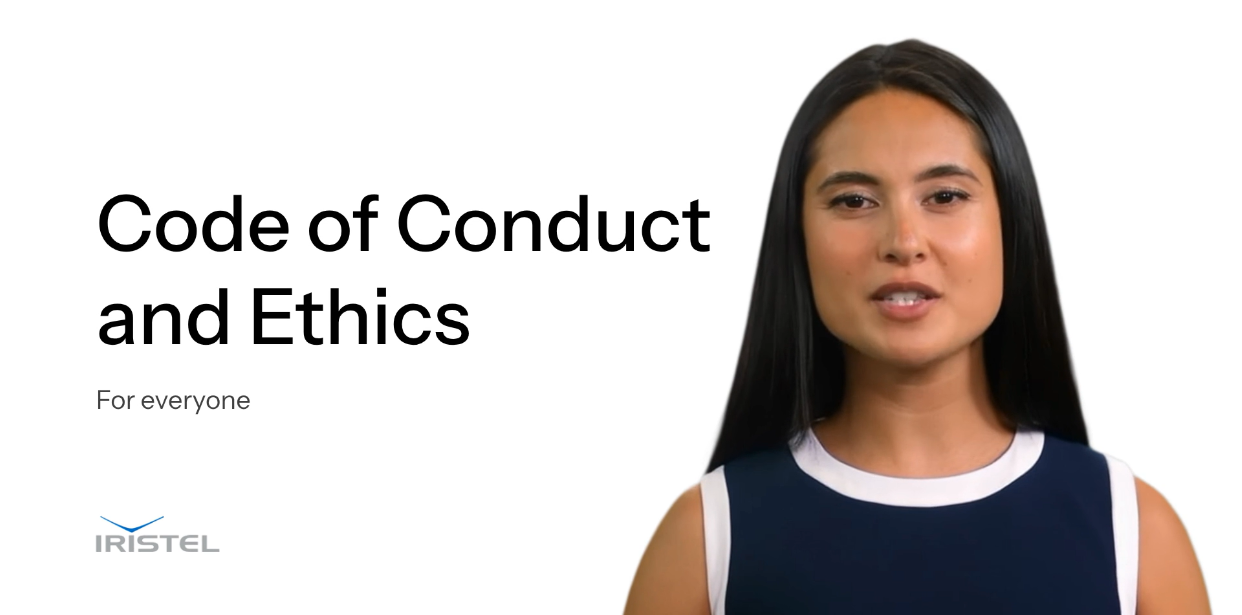
Welcome to Iristel's Code of Conduct and Ethics training. Whether you're an employee, a contractor, or a consultant, this short course applies to you. Over the next few minutes, we'll walk through the standards that keep our customers, our company, and our partners protected. Let's get started.
As a telecommunications provider, Iristel carries communications for businesses, government, wholesale carriers, and everyday consumers. Our customers trust us with their conversations, their personal information, and services they depend on every day. Every single one of us plays a part in protecting that trust.
Here's what you'll walk away with. You'll understand Iristel's ethical standards, and you'll be able to tell the difference between acceptable and unacceptable behavior. You'll know how to protect customer and company information, how to recognize security risks and report them, how to handle conflicts of interest, and what happens when policies are broken. Let's dive in.
Ethics are the foundation of trust. Customers rely on us to carry their voice traffic, handle their information carefully, and deliver reliable service. And it only takes one unethical action to undo that. A single bad decision can damage customer trust, harm our reputation, create legal exposure, trigger regulatory penalties, and cost real money. So ethics aren't just a nice idea — they protect the whole company.
Everything we do comes back to four principles. First, act honestly — tell the truth, be transparent, and never mislead. Second, act with integrity — do the right thing even when nobody's watching, and follow both company policy and the law. Third, act professionally — treat customers and colleagues with respect. And fourth, be accountable — own your actions, report mistakes promptly, and cooperate when there's a review. Honesty, integrity, professionalism, accountability.
So what's expected of each of us? Follow company policies, protect our information assets, report concerns when you see them, and support a culture of compliance. And just as important what you must never do. Never ignore a security concern, never conceal an incident, never bypass an established control, and never misuse company resources. When in doubt, speak up.
Let's talk about customer information. Iristel manages a lot of it account records, subscriber details, billing information, support histories, communications metadata, and service provisioning data. Customers trust us to keep every bit of that safe. Protecting it isn't optional it's core to who we are.
Confidential information comes in three flavors. There's customer information names, addresses, phone numbers, and billing records. There's business information pricing, contracts, vendor details, financials, and strategic plans. And there's technical information network diagrams, system configurations, security architecture, and anything about vulnerabilities. If it falls into one of these buckets, treat it as confidential.
Here are the ground rules. Only access the information your job actually requires that's the need-to-know principle. Store it only in approved systems, and protect it from anyone who shouldn't see it. On the flip side, don't share customer information with unauthorized people, don't copy it onto personal devices, don't email sensitive data to your personal accounts, and don't discuss confidential matters in public places like elevators or coffee shops.
Let's test it with a quick scenario. A friend asks you whether a specific phone number belongs to one of Iristel's customers. What do you do? The answer is simple you don't disclose anything. Politely let them know that customer information is confidential and can't be shared. No exceptions, even for people you trust.
Information security is everyone's job, and it starts with passwords. Use strong ones, keep them protected, and turn on multi-factor authentication wherever it's required. What you should never do is share your credentials, write passwords on sticky notes, or reuse the same password across different systems. Strong and private that's the rule.
A huge share of security incidents start with email. Be cautious with anything unexpected surprise attachments, odd links, or requests for your credentials. The warning signs of phishing are urgency, unexpected attachments, requests for passwords, and suspicious links. If something feels off, don't click. Report it to IT or Security, and delete it only if they tell you to.
Here's one you'll probably see for real. You get an email that looks like it's from Microsoft, asking you to verify your password. What now? Don't click anything. Report it to Security and follow the phishing reporting procedure. Legitimate companies don't ask you to confirm your password over email so treat that request as a red flag.
Company resources your computer, phone, network, and applications exist to support business work. Acceptable use means things like business communications, customer support, service delivery, and authorized research. Off-limits is anything illegal, harassment, installing unauthorized software, viewing inappropriate content, sharing confidential information, or getting around security controls.
Quick scenario: an employee installs unauthorized software just to make a task easier. Not allowed all software has to go through IT approval, because unapproved tools create security and licensing risks. A conflict of interest happens when your personal interests get in the way of your responsibilities to the company. For example, recommending a vendor owned by a family member, taking part in a decision about a company you own shares in, or doing work for a competitor. The expectation is straightforward avoid conflicts where you can, disclose the ones you can't, and cooperate with management's review.
Here's the scenario: you're evaluating telecom vendors, and one of the bidders is owned by a close relative. The right move is to disclose that relationship immediately, and step back from the decision if required.
Iristel stands for respect, inclusion, professionalism, and equal opportunity. That means harassment, bullying, discrimination, threats, and retaliation are never acceptable full stop. Communicate professionally, treat people well, and work through disagreements constructively. And if you see something cross the line say, a manager repeatedly humiliating employees in meetings report it through management, HR, or an established reporting channel.
We operate in a regulated industry, so compliance isn't optional and "I didn't know" is never an acceptable reason for breaking a policy. Complete your training, read the policies, and ask questions when you're unsure. When something's wrong a security or privacy incident, fraud, a policy violation, harassment, or a conflict of interest report it. You can go to your manager, Human Resources, Information Security, or Executive Management. And if you report in good faith, you're protected. Retaliation against you is strictly prohibited.
Let's finish with four quick telecom situations. One a friend asks you to look up a customer account. Decline, and report the request if it's appropriate. Two you find a service-impacting outage but figure someone else will report it. Don't assume report it immediately through the escalation channels. Three a vendor offers you expensive event tickets while a contract decision is pending. Decline or disclose it according to policy. And four you accidentally email customer information to the wrong recipient. Report it right away to Security and Privacy, and never try to hide it. Owning a mistake fast is always the right call.
That's it you've completed Iristel's Code of Conduct and Ethics training. By finishing, you're confirming that you understand your responsibilities, you'll comply with Iristel's policies, and you know your obligation to report concerns. Your last step is to sign the acknowledgment form. Thank you for doing your part to protect our customers, our company, and each other.
Thank you for joining on this demo. Here at Iristel we continue to look at ways to help improve and provide you with services that will impact your day to day and we look forward to continue to serve you in the future. Thank you for choosing Iristel.
Up next
8:26